Why does real estate tend to appreciate over time?
In this article
If you have ever talked to someone about investing, you have probably heard that real estate is one of the safest ways to preserve and multiply your money. But why is that? What makes real estate tend to appreciate over time? Let's break it down in a simple, straightforward way.
1. Demand keeps growing
One of the main reasons is the old law of supply and demand. The world keeps growing, people keep being born, families keep forming, and the need for a place to live or work never stops. Over the years, the number of people wanting to buy property increases. Even though the space available to build new properties does not grow at the same pace, the need for housing and commercial space keeps rising. In other words, the supply of real estate is limited, but demand only grows.
2. Inflation pushes prices up
Another important reason is inflation. When inflation rises, the cost of everything goes up, from building materials to the wages of the workers on the job. This means that building a new house or building will cost more than it did a few years ago. As construction costs rise, the value of existing properties ends up rising too. After all, if it is more expensive to build a new property, the value of one that is already built also tends to increase.
3. Improvements in city infrastructure
Cities are constantly evolving, always looking to improve their residents' quality of life. New schools, hospitals, shopping centers, parks, more efficient public transportation: all of this helps increase the value of the area and, as a result, of the properties located there. A property that used to be in a "dull" area can appreciate a lot when new infrastructure projects are carried out nearby.
4. Land scarcity
Space in the world is limited, and in cities this becomes even more evident. Large metropolitan areas such as São Paulo, Rio de Janeiro or New York have a limit to how much they can grow, especially in central and more desirable areas. With less land available, the lots that remain become more expensive, which drives up the value of properties that are already built.
5. Real estate is a tangible asset
Unlike stocks or cryptocurrencies, which are intangible financial assets (meaning you cannot touch them), real estate is something physical and real. You can visit it, live in it, rent it out or sell it when you need to. This gives investors greater security, because they know that even during crises or market swings, the property is still there. This sense of security makes real estate a sought-after investment, increasing its value over time.
6. A long-term investment
Real estate is seen as a long-term investment. Even if a property's value may not rise quickly in the short run, over years or decades it is almost certain to appreciate. People who buy with the future in mind, for retirement or as a way to secure financial stability, know that real estate has the potential to appreciate consistently.
7. The location effect
You know the saying “Location is everything”? It is very true in the world of real estate. A well-located property, whether in an area with good infrastructure, safety or proximity to shops, tends to appreciate much faster. If the area goes through improvements, such as a new subway line, shopping centers or companies moving in, the property's value rises even more. That is why a good location can be one of the main drivers of a property's appreciation.
Conclusion
Of course, not every property will appreciate in the same way or at the same speed. It depends on the location, the market, the state of the economy and other factors. Historically, however, investing in real estate has proven to be a safe and profitable choice. Anyone looking to protect their money against inflation while also having the chance of future gains will find real estate a very attractive investment opportunity.
In short, real estate tends to appreciate because of high demand, limited supply, inflation, city improvements and the fact that it is a tangible asset that offers investors security. If you are thinking about investing, know that with patience and a good choice of location, your property can be a great way to grow your wealth!
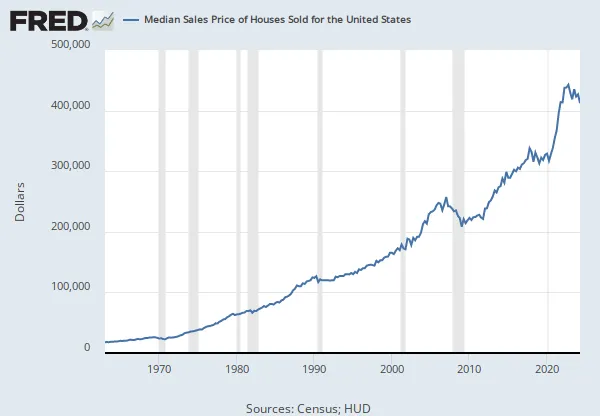
The chart below, covering the last 50 years and provided by FRED (Federal Reserve Economic Data), shows that real estate is gaining value between 88% and 92% of the time. The only people who lose are those who sell during these very short periods when prices hold steady or pull back, which usually return to the appreciation curve within about 18 months.