Can artificial intelligence bring down home prices? In some places, yes. In Central Florida, probably not

In this article
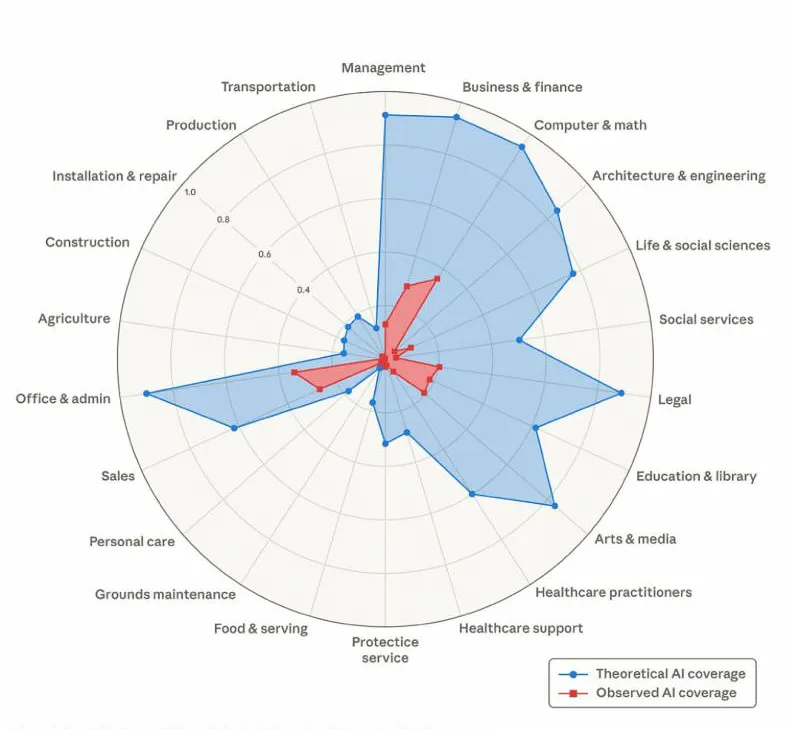
In recent months, several studies have begun to analyze the impact of artificial intelligence on the global job market. One of the most discussed was released by Anthropic, the company behind the AI system Claude, which analyzed the use of artificial intelligence in more than 800 occupations.
The results indicate that many roles tied to data analysis, administrative tasks and digital content production may undergo major transformation in the coming years.
This naturally raises an important question for investors:
If AI reduces jobs in certain sectors, could that affect property values?
The answer is: it depends on the local economy.
And this is exactly where the Central Florida real estate market stands out, with one of the most solid economic foundations in the United States.
The impact of AI will not be the same in every city
Artificial intelligence tends to mainly affect occupations that deal with structured digital information, such as:
administrative tasks
standardized financial analysis
repetitive programming
digital content production
data-driven technical support
These activities are common in highly corporate, digitized economies, especially in cities dominated by large office and tech hubs.
When a large part of a region's economy depends on these roles, automation can bring significant changes to the local job market.
And when jobs disappear, housing demand can be affected.
But that is not Central Florida's economic profile.
Central Florida's economy is built on the real world
The Orlando area has one of the most diversified economies in the United States, supported by sectors that depend on physical infrastructure, tourism and in-person services.
Among the region's biggest economic engines are:
Global tourism
The Walt Disney Company complex and Universal Orlando Resort draw tens of millions of visitors every year.
This flow supports a huge economic chain that includes:
hotels
restaurants
transportation
entertainment
events
retail
These activities require physical presence and human operation, something artificial intelligence cannot replace.
Rapid population growth
Florida is one of the states that attracts the most new residents in the United States. Families from many states keep moving to the region in search of:
a more pleasant climate
a lower tax burden
quality of life
good schools
economic opportunities
This population growth supports ongoing demand for housing.
Constant urban development
Areas such as:
Winter Garden
Horizon West
Clermont
Lake Nona
continue to receive major investment in infrastructure, new communities, schools and shopping centers.
This development cycle creates jobs in construction, engineering, retail and local services: sectors that do not depend on digital automation.
Why this protects the real estate market
Property values in a region are mainly determined by three factors:
1️⃣ population growth2️⃣ strength of the local economy3️⃣ limited housing supply
In Central Florida, all three factors remain extremely strong.
Even as artificial intelligence advances, the local economy relies heavily on sectors such as:
tourism
hospitality
construction
in-person services
local retail
These areas require physical infrastructure and human interaction, which makes automation much more limited.
This means the risk of massive job losses caused by artificial intelligence is significantly lower in the region compared with cities that are highly dependent on corporate technology.
AI may affect some cities, but not all of them
Regions whose economies rely heavily on digital sectors may face adjustments in the future.
Cities dominated by:
large financial centers
corporate back-office operations
large-scale digital services
technical support that can be automated
may eventually feel bigger impacts.
But regions with economies based on global tourism, population growth and urban development tend to keep much more solid fundamentals.
And that is exactly Central Florida's profile.
What smart investors look at
Experienced real estate investors know that the true engine of property appreciation is not just technology or short-term trends.
What sustains property values over the decades is the structural strength of the local economy.
In Central Florida, that structure continues to be supported by:
one of the largest tourism hubs on the planet
steady population growth
planned urban expansion
strong housing demand
These factors create a solid foundation for the region's real estate market.
Conclusion
Artificial intelligence will certainly transform many sectors of the global economy in the coming years.
However, its impact will vary greatly depending on the economic structure of each region.
While some cities that are highly dependent on digital work may face deeper changes, regions like Central Florida continue to be supported by sectors that depend on the physical world and human presence.
That is why, despite the technological changes now emerging, the fundamentals that support the Central Florida real estate market remain strong.
And it is exactly this economic foundation that explains why the region remains one of the most attractive in the United States for anyone looking to invest in real estate with a long-term view.