
Are US home prices high, or have they just kept pace with wages? A strategic view for investors
In this article
When we look at the US real estate market today, it is common to hear: “homes are way too expensive.” But is that really true? For anyone who wants to invest, it is important to look beyond first impressions and make a fair comparison: instead of looking at the price of a home in isolation, the ideal is to compare it with the population's average income and with the inflation accumulated over the decades.
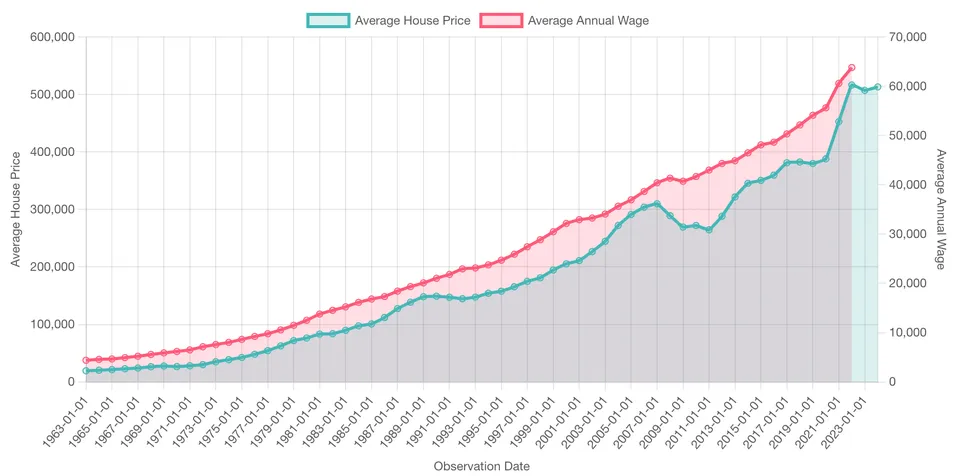
That is exactly the purpose of the analysis published by TimeTrex, which cross-referenced historical data on average home prices with the evolution of wages since the 1960s. The result offers a clearer (and surprising) view of what really happened across generations. The relationship between how much people earn and how much a home costs (in years of salary) shows that, despite recent increases, home appreciation has reasonably kept pace with the growth of income and inflation in the country.
In this article, we will summarize the main points of the study, highlighting the most relevant historical moments, such as the 2008 crisis and the surge in prices after the pandemic. We will also look at how different generations faced the challenge of buying a home and, finally, show why the US real estate market remains one of the safest and most solid long-term investments, including for Brazilians who want to dollarize their wealth.
Historical evolution: home prices vs. average salary
The analysis starts in the 1960s, when a typical US home cost about $19,375, and the average annual salary was roughly $4,400. That means the average buyer needed 4.4 years of gross salary to buy a home.
Over the decades, that relationship changed. At the turn of the 1980s, the United States faced high inflation and high interest rates, which affected both wages and home prices. An average home came to cost about $149,000, while the average salary was $21,000, pushing the ratio to about 7 years of salary.
In the 1990s and early 2000s, things stabilized. Prices rose gradually, wages kept pace, and the ratio stayed in the range of 6 to 7 years, until the pre-crisis peak of 2008.
The 2008 crisis and the recovery
Before the subprime crisis, the salary-to-home-price ratio reached 7.7 years, a warning sign of the housing bubble that was about to burst. After the collapse, prices fell, but wages kept growing slowly, leading to a recovery in affordability. In 2012, the ratio reached 5.4 years of salary, one of the best moments in history to buy property in the US.
As the economy heated up in the following years, with low post-crisis interest rates, the market returned to healthy growth, restoring confidence among both Americans and foreign investors.
The impact of the pandemic and the current situation
The COVID-19 pandemic brought an explosion in housing demand, driven by historically low interest rates, fiscal stimulus and lifestyle changes (with more people looking for larger homes or homes outside city centers). This made the average price of a home jump from $387,900 in 2020 to $516,425 in 2022.
On the other hand, wages also grew: from about $55,600 in 2020 to $74,580 in 2024, which kept the price-to-salary ratio relatively stable at around 7.5 years, a figure that, although high, is within the historical average observed over recent decades.
Comparison by generation
The analysis also compares purchasing power across generations:
Baby Boomers (1960s to 1980s) bought homes at a ratio of 3.7 to 5.5 years of salary, amid inflation and unstable monetary policy.
Generation X (1990s to 2000s) faced the peak of the bubble, with the ratio reaching 7.7 years.
Millennials (2010 to 2020) entered the market during the post-crisis recovery, one of the most balanced moments.
Generation Z (2020 to today) is dealing with high prices, but also with higher wages and more access to technology and information, which allows for more strategic choices.
Conclusion: an opportunity for investors
Despite all the alarm, the data shows that US home prices have grown fairly consistently with wages and inflation. We are not facing a bubble like in 2008, but rather a market that has gone through a repricing, something natural in cycles of economic growth.
For real estate investors, this means the market remains solid, predictable and with strong appreciation potential over the long term. Especially when we consider the effect of leverage (financing), the generation of passive income through rentals, and the fact that the shortage of new homes is still a problem in the US, which tends to keep demand strong and prices appreciating.
📌 Summary for investors
📈 Prices went up, but so did wages.
📊 The price-to-salary ratio is within the historical average.
🏘️ Limited supply favors future appreciation.
💼 Financing is still a good leverage strategy.
💵 Real estate remains an excellent way to protect wealth against inflation.